The Chairman's Bit
About 11.00 am on Sunday 29th September, Gill and I stopped for coffee at Urquhart Castle
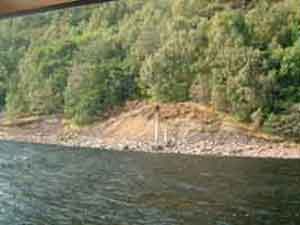
before meeting James Campbell at the John Cobb Memorial to lay a wreath. It was
eerie to see the Loch flat calm - just as it must have been 50 years before.
Having been to the excellent exhibition at Drumnadrochit the day before, it was easy to
imagine the scene as Cobb made his fatal record attempt. The noise must have been
incredible - and the silence after the accident was apparently just as intense. Some 40 members
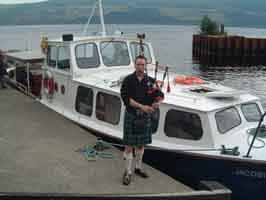
, friends and guests came with us on the "Jacobite Warrior" on what could not have been a
better day weatherwise or in terms of the arrangements. We sailed down to the
measured mile where Rev. Hugh Lawson conducted a moving and very appropriate service;
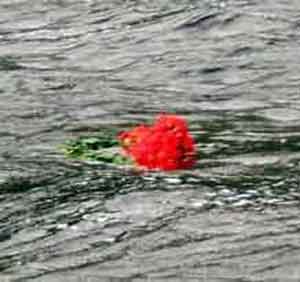
Andrew MacKenzie played a lament on the pipes; and we laid a wreath on the water -
"Honour to the brave and to the humble".
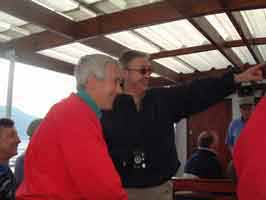
It was a memorable day - both poignant and moving but also enjoyable and fascinating to hear
from those who were there at the time. On behalf of the Club, I must record our very sincere
thanks to James Campbell whose idea it was and who put such a great deal of effort
into making the day such a success.
|
|
The following tribute to John Cobb was received from Richard Noble who, as a boy, was inspired
by Cobb's exploits. It was read out by James Campbell during the service on Loch Ness and gives
an interesting view from a fellow professional of a brave but unassuming man.
|
|
JOHN RHODES COBB 1899 - 1952
In this brash and in your face age - where everything is about show and spin, today's
media would have had serious problems with the quiet giant John Cobb, a man reluctant to
give interviews or face the camera and yet driver of the most powerful racecars of the age.
He held the World Land Speed record with such an outstanding performance that his
Land Speed records stood from 1938 to 1964 when his record was raised by a mere 8.9 mph.
Even today 64 yearslater the wheel driven speeds are now only 50 mph faster.
He was the record breakers' record breaker.
John Cobb came straight into racing driving the most powerful cars at Brooklands in 1925.
He didn't seem to require any kind of gradual introduction - his learning
curve was steep and he held the outright lap record at Brooklands in 1929, 1932 (twice), 1933,
1934 (twice) and 1935 which turned out to be in perpetuity. The 1935 record was a
staggering achievement - a lap record of 143.44 mph in the Napier Railton - an aero engined
monster car with cart spring suspension. To average 143 mph the car had to exceed
160 mph on that rough dangerous Brooklands banking with no Armco and the driver with no better
protection than white cotton overalls and a white cotton apology for a helmet.
Whilst he was famous for his endurance records which extended as far as 5,000 kilometers at
134.79 mph on the Bonneville Salt in 1935 - his greatest achievement was undoubtedly the Land
Speed record. Cobb set out to design and build the ultimate Land Speed record car.
While other record breakers maintained high public profiles and raced very
conventional aero-engined powered designs, Cobb cultivated a subterranean media profile
and teamed up with Reid Railton and the firm of Thomson & Taylor to create a masterpiece -
the Railton Mobil Special.
It must have taken great mutual confidence for that team to design, build and race such
an unconventional car - there were many reputations on the line.
The car had two vast Naiper Lion aero engines mounted on a cranked spinal chassis so that the
rear engine drove the front wheels and the front the rear. The driver sat bolt
upright in the front with several tons of thrashing red hot engines and high octane fuel
directly behind him. The overall package was the most aerodynamic and beautiful
Land Speed record car ever produced, but Cobb's chances of survival in an accident would
have been non existent.
Imagine driving the huge four wheel drive monster with no driveline connection between the
front and rear wheels so that you have to balance the throttles. You are seated
out front like a bus driver with a huge steering wheel in your lap and little feel for what
was happening behind you. Then imagine doing it at 400 mph with the car at the
limits of adhesion and without the comfort of a tail fin to keep you straight.
During the War as a pilot John Cobb delivered fighters and bombers and then found himself
with a problem. His last return to Bonneville in 1947 had raised the Land Speed
record to 394.19 mph and Brooklands had been sold for redevelopment.
Having run out of automobile challenges, he chose to follow Sir Henry Segrave and
Sir Malcolm Campbell onto water.
As always, Cobb pioneered the ultimate design - Crusader was the first jet viable powered
boat at a time when all conventional aircraft had propellers. Crusader was named by
Cobb because "in the old days a Crusader was a man who liked to get away from his office and
have some fun". The design was an unusual reverse three pointer and the engine a
de Havilland Ghost - the same engine fitted to the World's first Jet airliner - the de Havilland
Comet.
Footage shows the boat as being very fast and reliable but with a tendency to pound.
Cobb described the experience "like driving a London omnibus with no springs on a cobbled road".
He did that too in the General Strike in 1926.
Driving Crusader must have been a demanding experience - once it was on the plane the water
resistance would have been minimal and the boat would have streaked away like a rocket with
absolutely relentless acceleration and speed. It pounded badly and that would have
made it difficult to read the instruments - but what a ride!
Cobb ever the speed king would have loved the challenge.
Sadly, as we know, Crusader broke up 50 years ago and Cobb died from shock.
Even in death he maintains his modesty - he is buried with his parents and his name is difficult
to find. But his cars live on - you can find the Napier Railton at Brooklands and the
Railton Mobil Special in Birmingham.
If you ever decide to study an amazing driver deal from the life of a very great man - choose
John Cobb - you'll learn a very great deal from the life of a very great man
Richard Noble (September 2002)
|